
STANDAGE, DCP, Joint Study Begins on a Trade Platform Integrated with Payment Services Aimed at Commercialization in FY2028
Achieving simultaneous settlement (DvP) by linking eBL with The Shoko Chukin Bank’s tokenized deposit “DCJPY” to strongly promote overseas expansion and trade DX for SMEs and mid-sized enterprises
STANDAGE Inc. (Head Office: Minato-ku, Tokyo; President and CEO: Akinori Adachi; hereinafter “STANDAGE”) and DCP Co., Ltd. (Headquarters: Chiyoda-ku, Tokyo; Representative Director, President, Executive Officer, CEO and COO: Yoshio Hirako; hereinafter “DCP”) have begun joint discussions on a trade platform (PF) integrated with settlement functions, with the participation of The Shoko Chukin Bank, Ltd. (hereinafter “The Shoko Chukin Bank”). With the cabinet approval this October of the bill to amend the Commercial Code legalizing electronic bills of lading (eBL), and its enforcement expected within fiscal year 2027, the companies will verify simultaneous settlement linking eBL with “DCJPY,” a tokenized deposit (*1) issued by The Shoko Chukin Bank. Aiming for commercialization in fiscal year 2028 in anticipation of the full-scale adoption of eBL, this initiative seeks to achieve “synchronization between the digitization of commercial flows and the flow of funds” and, in the future, “greater transparency and faster processing of the flow of funds.”
■Background and Social Issues
In current trade practices that rely on paper bills of lading (BLs), the risk of non-payment and the time lost in mailing paper documents are factors that strain the cash flow of small and medium-sized enterprises. Furthermore, the problem of high demurrage charges incurred when cargo arrives before the bill of lading is becoming increasingly serious, making efficiency gains through digitization an urgent priority.
Currently, efforts to establish the necessary infrastructure for the digitization of trade and finance are progressing rapidly both domestically and internationally. Following the lead of major countries that have enacted legislation in line with the United Nations Commission on International Trade Law (UNCITRAL) Model Law on Electronic Transferable Records (MLETR), legal reforms are progressing toward the enforcement of eBL-related laws, with a bill amending the Commercial Code for electronic bills of lading approved by the Cabinet on October 23. Furthermore, against the backdrop of the government’s “Basic Policy on Economic and Fiscal Management and Reform 2026” explicitly calling for the promotion of on-chain finance, as well as the need for advanced compliance measures (AML/CFT) in the banking industry resulting from stricter FATF reviews, the transition to next-generation settlement infrastructure utilizing blockchain has become an unavoidable choice.
Against this backdrop, the introduction of electronic bills of lading (eBL) and other digital solutions is advancing the digitization of “commercial flows (documents and data),” creating an environment that seamlessly links digital data with the actual movement of cargo—“logistics (cargo movement).” However, true efficiency across the entire trade procedure cannot be realized as long as the final “financial flows (payment settlement)” remain disconnected from them. Furthermore, traditional cross-border remittances via SWIFT and other networks require considerable time and cost before funds are received, and the resulting cash flow uncertainty continues to hinder the global expansion of SMEs and mid-sized enterprises.
To eliminate this “disconnection between commercial/logistical flows and financial flows”—the biggest bottleneck in trade DX—we have commenced joint discussions using this model and are proceeding with preparations for future pilot tests.
■Purpose
This initiative aims to demonstrate, in its first phase, the “digitization of commercial flows and their synchronization with financial flows” by linking trade documents—such as eBL—with tokenized deposits, thereby establishing a practical operational model targeted for commercialization in fiscal year 2028. Through this, the initiative seeks to eliminate time lags and improve operational efficiency in trade operations for SMEs and mid-sized enterprises. Furthermore, with a view toward future connection to cross-border payment networks, the initiative aims to evolve toward “enhancing the transparency and speed of financial flows.” In doing so, it will contribute to the development of a sustainable social and industrial infrastructure by reducing the overall costs of trade procedures in Japan, ensuring supply chain transparency, and enhancing supply chain resilience.
■Contributions to the Trade Community and Related Industries
To address challenges in traditional trade practices, this initiative aims to establish a DvP settlement scheme that integrates electronic bills of lading (eBL) with the tokenized deposit “DCJPY.” We anticipate the following benefits from the implementation of this scheme:
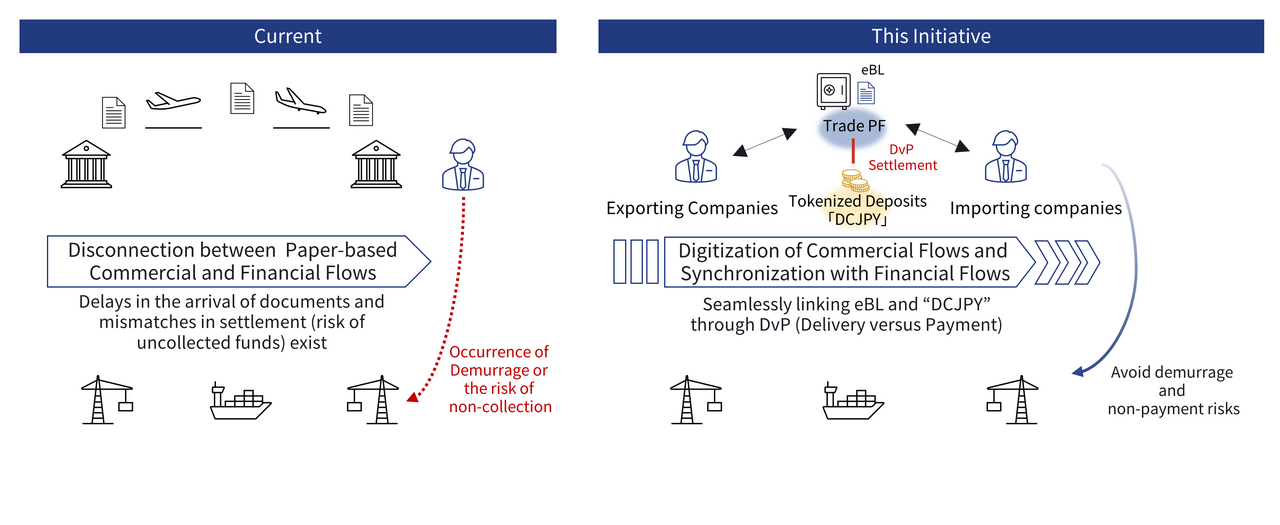
- Reducing the Risk of Uncollected Receivables for Exporting Companies and Accelerating Cash Collection: By integrating STANDAGE’s eBL platform from CargoX (*2) with DCP’s tokenized deposit platform “DCP,” we aim to achieve reliable DvP (delivery versus payment) through automated processing via smart contracts. This will significantly reduce the risk of non-payment associated with the advance delivery of goods. Furthermore, by going paperless, we will reduce delivery costs (such as international courier fees) and administrative expenses associated with the exchange of traditional paper documents, while also eliminating the time lag caused by mailing documents and shortening the lead time from shipment to payment collection.
- Avoid Demurrage and Flexible Payment Terms for Import Companies: Enabled by 24/7 smart contracts, importers can complete procedures online at any time aligned with container movements, free from physical constraints like mailing paper documents or visiting bank branches. Following standard bank verification, eBL title transfer and settlement can proceed—preventing cargo collection delays caused by late-arriving documents and avoid costly demurrage and other additional charges.
- Implementation of Seamless Digital Trade Payments: On DCP’s tokenized deposit platform, “DCP,” we provide a secure environment for large-scale digital payments using the tokenized deposit “DCJPY.” Companies do not need to build large-scale systems or change their accounting workflows; they can use it just as they would a regular deposit account.
- Improving Operational Efficiency and Structural Reform Through Paperless Initiatives: By digitizing and centralizing trade procedures, we will drastically reduce ancillary costs such as postage and processing time. By leveraging blockchain technology to enhance transparency and resilience, while eliminating the physical transport of paper documents to reduce environmental impact (CO2), we will build a sustainable and efficient next-generation trade infrastructure.
■Ripple Effects on Related Industries Resulting from the Establishment of This Model
- Financial Institutions’ Rapid Entry into Trade Digital Transformation and System Scalability: This highly scalable network infrastructure is designed so that, in the future, other financial institutions can issue tokenized deposits on the “DCP” tokenized deposit platform and easily integrate them with STANDAGE’s trade platform, “Digitrad Payments.” Furthermore, the design is flexible enough to extend beyond domestic settlement infrastructure, accommodating future expansion into cross-border remittance networks.
- Immediate Adoption of Trade Digital Transformation and Strengthening of Governance for Small and Medium-Sized Enterprises Through Financial Institutions: Since financial institutions can utilize the platform under consideration with minimal system modifications, small and medium-sized enterprises will be able to quickly adopt the latest trade digital transformation (DX) mechanisms through their regular financial institutions without the need for major system upgrades. At the same time, advanced AML/CFT (anti-money laundering and counter-terrorist financing) management utilizing digital audit trails and the shift to paperless operations will strengthen governance and significantly streamline administrative processes for financial institutions.
■ Future Developments for Both Companies
Through future pilot tests, the two companies will accelerate the establishment of regulatory frameworks, technologies, and operational workflows with a view to launching commercial services in fiscal year 2028.
- STANDAGE: We will quickly integrate this payment functionality into “Digitrad Payments” to achieve a fully paperless trade process and instant settlements. By eliminating the complexity of procedures and payments, we will support small and medium-sized enterprises in taking on new trade transactions and achieving sustainable sales growth.
- DCP: By providing advanced digital payment infrastructure through the tokenized deposit platform “DCP,” we will promote the creation of a next-generation economic ecosystem co-created by financial institutions and platform providers. Equipped with “the security of bank deposits and strict compliance,” this scheme serves as a robust model for large-scale B2B payments by seamlessly linking digital trade data with fund settlements on banking systems, thereby accelerating industrial digital transformation (DX). Looking ahead, with an eye toward integration with international payment networks such as “Partior,” we will strongly support companies in improving their fund efficiency by evolving traditional cross-border remittances toward “greater transparency” and “faster processing.”
(*1)Tokenized Deposits: A system that utilizes technologies such as blockchain to enable the digital management of bank deposits. When combined with smart contracts (automated programs) and other technologies, it enables advanced operational automation and instant settlements.
(*2)CargoX: CargoX is a global electronic bill of lading (eBL) management platform developed by CargoX, Inc. and approved by the International P&I Group (a mutual marine insurance association). It also meets the international interoperability requirements established by the non-profit organization DCSA (Digital Container Shipping Association) and is recognized as a highly scalable and reliable system capable of enabling seamless data exchange between different eBL platforms in the future.
[For Reference]
The Shoko Chukin Bank's Announcement Regarding This Initiative: For The Shoko Chukin Bank's announcement regarding this initiative, please refer to the company's press release issued on the same day.
https://www.shokochukin.co.jp/assets/pdf/nr_261028_01.pdf
■ Company Overview
Company name: STANDAGE Inc.
Established: March 7, 2017
Representative: Akinori Adachi, Representative Director, President & CEO
Head office: Sumitomo Fudosan Landmark Plaza 3F, 1-6-7 Shibakoen, Minato-ku, Tokyo 105-0011, Japan
Capital: JPY 367 million
Business: Development and provision of digital trade platforms (Boeki Cloud and Digitrad Payments) and blockchain-based trade settlement systems; export support services for SMEs and mid- sized companies, including overseas sales-channel development and trade operations on their behalf ("Omakase Boeki")
URL: https://wp.standage.co.jp/us/
Company name: DCP Co., Ltd.
Established: December 27, 2021
Representative: Representative Director, President, CEO and COO, Yoshio Hirako
Location: 2-10-2 Fujimi, Chiyoda-ku, Tokyo
Capital : JPY 100 million
Business description: Digital Currency Business/Electronic Payment Agent Kanto Regional Finance Bureau (Electronic Payment Agent) No. 150
URL: https://www.dcjpy.com/en/

